

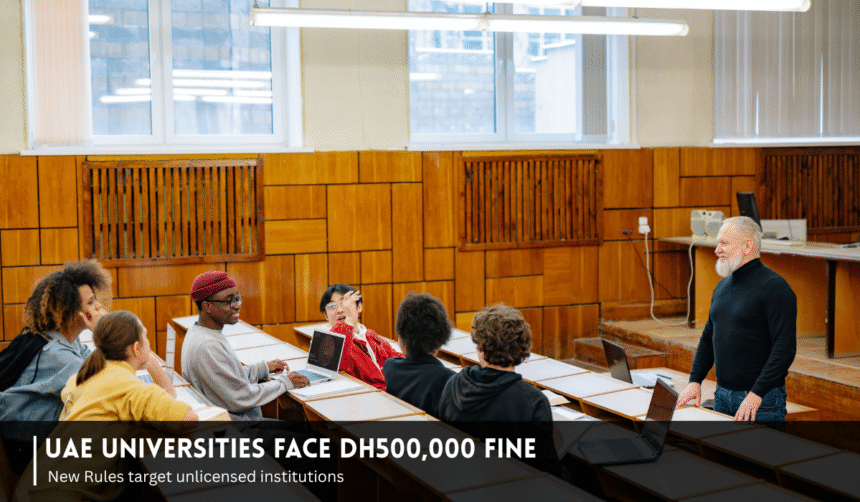
Higher education institutions operating in the UAE without the required license or approval could soon face a Dh500,000 fine and immediate closure under new rules aimed at strengthening oversight of the sector.
The measures will take effect on September 12, 2026, giving the Ministry of Higher Education and Scientific Research stronger powers to deal with institutions that operate outside the country’s regulatory framework.
While the penalties are substantial, the rules also place considerable emphasis on students. Institutions facing action will still be responsible for protecting students’ academic and financial rights, including helping ensure their education is not unnecessarily disrupted.
Dh500,000 Fine for Operating Without a Licence
Under the new rules, higher education providers found operating without the required licence or approval can be closed immediately and fined Dh500,000.
The Ministry of Higher Education and Scientific Research will be responsible for imposing administrative penalties and other measures when institutions breach the laws and regulations covering the sector.
The tougher approach is intended to make it harder for unauthorised providers to operate while giving legitimate institutions a clearer regulatory environment.
Higher education providers are expected to meet the necessary licensing requirements before they begin operating, while academic programmes must also have the appropriate approvals before being offered to students.
For institutions that fail to meet those requirements, the consequences can now go well beyond a warning or financial penalty.
Students Protected When Institutions Face Action
One of the most important parts of the new framework concerns students who may find themselves enrolled with a provider facing regulatory action.
If an institution is closed or penalised, it will still have obligations towards its students.
Their academic and financial rights must be protected, and steps should be taken to allow them to continue their education where possible.
This matters particularly for students who may have already paid tuition fees or spent months or years working towards a qualification.
Institutions could also be required to refund fees or other payments collected from students when they had no legal right to receive them.
The approach is intended to prevent students from bearing the consequences of regulatory failures that were outside their control.
Repeat Violations Could Bring Tougher Penalties
Institutions that continue operating after being ordered to close could face further action.
The ministry can work with local authorities, economic departments and other government bodies to stop an unauthorised provider from continuing its activities or attempting to restart them in another form.
Repeat violations could bring even more serious consequences.
Persistent offenders may ultimately be prevented from returning to the education sector altogether.
The rules allow an offending institution, its owners and those exercising effective control over it to be permanently prohibited from establishing, owning, managing or controlling a higher education institution.
Those restrictions can also extend to technical and vocational education and training providers.
This means individuals responsible for repeated serious breaches may not simply be able to close one institution and establish another under a different arrangement.
UAE Tightens Oversight of Higher Education
The penalties come as the UAE continues to strengthen regulation across its rapidly developing higher education sector.
Universities, colleges and other providers serve a diverse student population, including Emirati students and thousands of international students who choose the country for higher education.
Clear licensing and accreditation requirements are particularly important in such a market. Students need to know that the institution they choose is properly authorised and that the programme they are paying for meets the required standards.
The latest rules give regulators stronger options when those standards are ignored.
They also underline the responsibility institutions have towards students even when they themselves are facing penalties.
What Students Should Check Before Enrolling
For students and parents, the changes are also a reminder to check an institution’s credentials before committing to a course.
Before paying tuition fees or accepting an offer, prospective students should confirm that the institution is properly licensed and that the programme they plan to study has the necessary approval.
That check can be especially useful when dealing with unfamiliar providers or courses promoted heavily through websites and social media.
Professional advertising or an impressive campus does not necessarily prove that an institution or programme has received the required regulatory approval.
From September 12, providers that ignore those requirements face much tougher consequences.
A Dh500,000 fine is the headline penalty, but the wider rules go further. Immediate closure, possible refunds for students and permanent restrictions for persistent offenders make clear that operating without approval could have lasting consequences.
For students, the changes offer an additional layer of protection at a point when choosing the right institution can involve a significant investment of both time and money.