
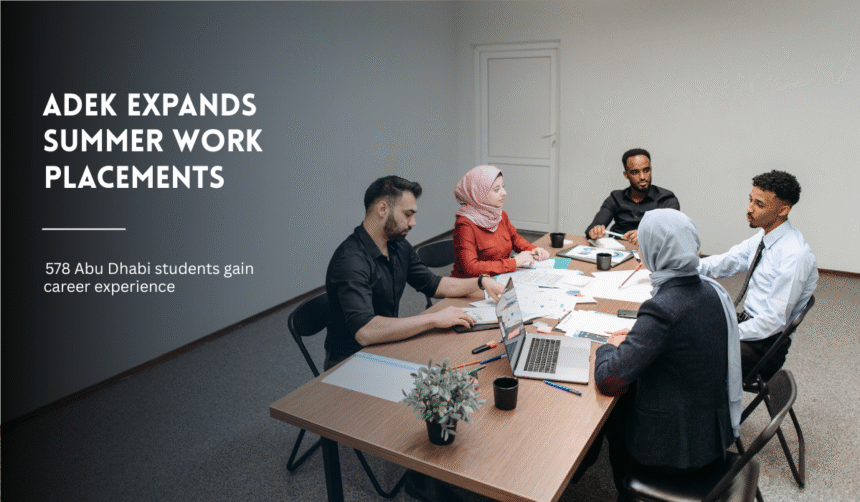
Hundreds of high school students in Abu Dhabi swapped part of their summer break for the workplace this year, gaining first-hand experience across a range of industries and a closer look at possible future careers.
The Abu Dhabi Department of Education and Knowledge (ADEK) expanded its Work Placement Program for Summer 2026, giving 578 students the opportunity to spend time inside professional organisations across the emirate.
Demand was significantly higher than the number of places available. More than 2,900 students applied for the programme, highlighting strong interest among young people looking to explore career options before leaving school.
The initiative builds on a pilot programme introduced last year and aims to bridge the gap between classroom learning and the realities of professional life.
Students Step Into the Workplace
This summer, students were placed with 23 industry partners across Abu Dhabi and Al Ain, gaining exposure to sectors including technology, healthcare, banking and hospitality.
Placements lasted between one and two weeks during the school break and were structured around defined learning outcomes.
Students were not there simply to observe. The programme was designed to involve them in meaningful workplace activities, allowing them to experience professional responsibilities and understand how organisations operate on a day-to-day basis.
For students who are still considering what to study or which career path to follow, that kind of exposure can provide useful perspective. Seeing an industry from the inside can offer a clearer understanding of different roles, working environments and the skills employers value.
It can also help young people identify areas that genuinely interest them before they make decisions about further education and future careers.
Preparing Students for Professional Life
Before beginning their placements, participants attended a dedicated preparation session covering professional conduct, workplace expectations and UAE values.
The aim was to ensure students arrived with a better understanding of how to behave and communicate in a professional environment.
The programme also addressed how the world of work is changing.
The Ministry of Human Resources and Emiratisation delivered a workshop on artificial intelligence and the future of work, introducing students to some of the ways emerging technologies are influencing careers and workplaces.
The session added a forward-looking element to the programme, encouraging participants to consider not only the jobs available today but also the skills that could become increasingly important as industries evolve.
Building Confidence and Workplace Skills
The benefits of work experience can extend beyond learning about a particular profession.
For many students, entering a professional workplace for the first time means adapting to a new environment, communicating with colleagues and taking responsibility for assigned tasks.
These experiences can help young people develop confidence while giving them a practical understanding of workplace expectations.
Feedback gathered from students, parents, career counsellors and participating employers has indicated positive outcomes in areas including confidence, workplace skills and students’ ability to make more informed education and career choices.
The programme also creates an opportunity for employers to connect with younger generations.
By hosting students, participating organisations can introduce them to different industries and contribute to the development of skills that could support Abu Dhabi’s future workforce.
Connecting Education With Careers
Career decisions can be difficult to make when a student’s knowledge of an industry comes mainly from classroom lessons, online research or conversations with others.
Spending time in an actual workplace offers a different perspective.
Students can see how teams operate, how employees communicate and how different roles contribute to an organisation. They can also begin to understand how skills developed at school may be applied in a professional setting.
That connection between education and employment is at the heart of the expanded summer initiative.
The level of demand this year also shows how strongly students are responding to opportunities for practical career exposure. With more than 2,900 applications for 578 places, the programme attracted several times more applicants than available placements.
For the students who secured a place, the experience offered more than a different way to spend part of the summer.
They had an opportunity to step outside the classroom, experience professional life first-hand and gain a clearer understanding of what different careers involve.
As they return to school and begin thinking about their next steps, those lessons could help them approach future education and career decisions with greater confidence and a better understanding of the working world.