
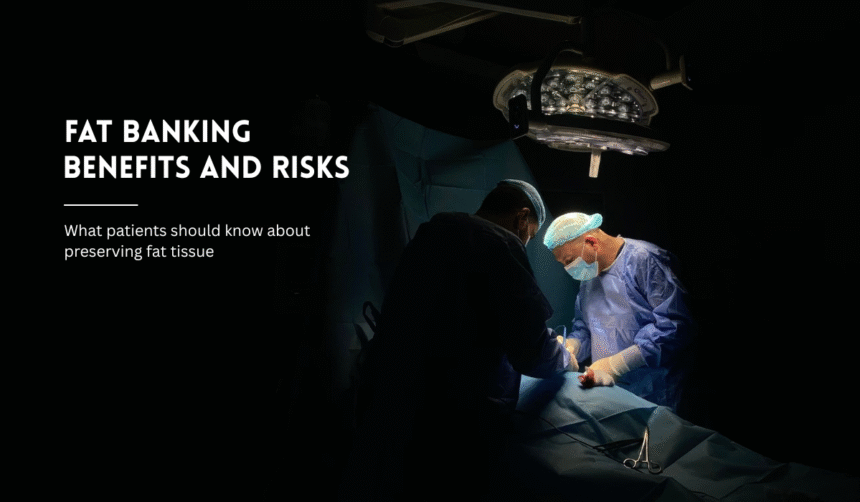
Fat removed during liposuction has traditionally been discarded unless it was needed immediately for another procedure. But growing interest in cosmetic and reconstructive medicine is bringing more attention to another option: storing a patient’s own fat for possible use in the future.
Known as fat banking, the process involves collecting adipose tissue, preparing it under controlled conditions and preserving it at very low temperatures. If needed later, the stored tissue may potentially be used for procedures such as autologous fat grafting, where a person’s own fat is transferred to another part of the body.
For patients, the idea can sound appealing. However, fat banking is an evolving area of medicine and experts say it is important to understand both its potential and its limitations.
Why Bank Fat?
One of the main reasons is practical.
A patient undergoing liposuction may have more fat removed than is needed for an immediate procedure. Storing some of that tissue could potentially make it available for another fat-transfer procedure later.
This may be particularly relevant for people who expect to undergo several grafting sessions. Instead of harvesting fresh fat each time, previously stored tissue could potentially be used, reducing the need for another collection procedure.
A systematic review published in Tissue Engineering Part B: Reviews examined 59 studies and found encouraging results with some cryopreservation methods. However, researchers also found considerable variation between techniques and concluded that the ideal protocol for preserving autologous fat has yet to be established.
What Happens When Fat Is Frozen?
Fat is living tissue, which makes preserving it more complicated than simply placing it in a freezer.
The way tissue is collected, cooled, stored and eventually thawed can influence its quality. Storage temperature, cooling and warming rates and the use of cryoprotective substances can all play a role.
A separate 2025 review of recent research concluded that cryopreservation shows promise for future plastic and reconstructive surgery. It also noted that thawing can result in cell death and changes to the tissue’s extracellular structure.
For patients, this means stored fat should not automatically be assumed to behave exactly like freshly harvested tissue. Methods can differ between providers, making it important to understand how a facility processes and stores samples.
Why Are Stem Cells Part of the Conversation?
Fat banking has also attracted attention because adipose tissue contains different cell populations that are being investigated in regenerative medicine.
That research has created excitement about what stored tissue might potentially offer in the future. But this is also an area where patients need to separate scientific research from established medical treatment.
Banking fat does not guarantee that the tissue will provide access to future stem cell therapies.
Many regenerative applications involving fat-derived cells remain under investigation, and patients should be cautious about claims suggesting that storing fat today guarantees treatments for diseases in the future.
The US Food and Drug Administration has warned consumers about unapproved regenerative medicine products, including products involving fat-derived cells. The agency says products marketed as regenerative treatments may require regulatory approval and cautions that unapproved therapies may not have been shown to be safe or effective.
What Are the Risks?
The first consideration is how the fat is collected. Liposuction is an invasive medical procedure with potential risks and complications that should be discussed with a qualified medical professional.
Storage creates another set of questions.
Patients should know where their tissue will be kept, how it will be monitored and what happens if a sample is damaged, contaminated or becomes unsuitable for use.
There are practical considerations too. Fat banking may involve an initial processing charge followed by ongoing storage fees, potentially for several years.
And there is no guarantee the stored tissue will ever be needed.
What Should Patients Ask Before Deciding?
Anyone considering fat banking should start with a simple question: What am I realistically storing this tissue for?
Patients should ask which procedures the stored fat can currently be used for, how long it can be preserved and what evidence supports the storage technique being offered.
It is also worth asking about the facility’s licensing and quality standards, how samples are identified and protected, the retrieval process, ongoing costs and what happens if the storage provider stops operating.
Most importantly, patients should discuss the decision with an appropriately qualified doctor who can explain the difference between established uses and experimental possibilities.
Fat banking could offer practical benefits for some people, particularly those who may require future fat-grafting procedures. Research into cryopreservation is also continuing to improve understanding of how adipose tissue can be stored successfully.
But the technology should be approached with realistic expectations.
For now, banked fat is best viewed as tissue that may provide options for future procedures, rather than a guarantee of future regenerative or stem cell treatment.