

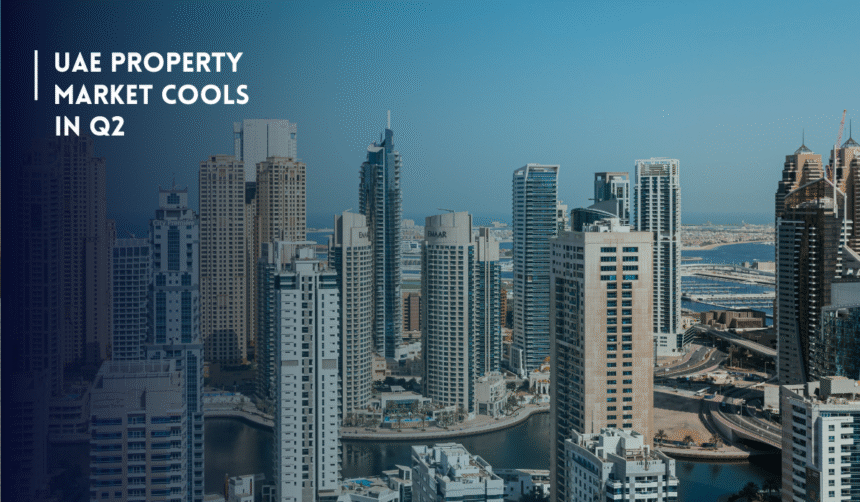
The UAE property market showed signs of slowing in the second quarter of 2026, with home prices and rents easing in Dubai and Abu Dhabi after several years of strong growth.
The latest figures point to a shift in market conditions as more homes become available and buyers and tenants take a more considered approach to property decisions. While quarterly prices have declined across several segments, annual growth remains strong in parts of the country, particularly Abu Dhabi.
Data from real estate consultancy Colliers shows that the change is not uniform across the UAE. Instead, individual cities, communities and property types are beginning to move at different speeds.
Dubai Property Prices Ease in Q2
In Dubai, average apartment and villa sale prices fell by around 3 per cent compared with the first quarter of 2026.
Rents also moved lower. Apartment rents declined by 4 per cent quarter-on-quarter, while villa rents fell by 2 per cent.
For tenants, the change could offer some relief after a prolonged period of rising housing costs. Dubai’s rental market has experienced significant increases in recent years as population growth and demand for homes placed pressure on available properties.
The latest figures suggest those pressures may be starting to ease in some parts of the city.
New housing supply is playing an important role. Around 11,650 residential units were completed in Dubai during Q2, including approximately 9,200 apartments and 2,450 villas.
More homes are on the way. About 56,600 residential units are scheduled for completion by the end of 2026, increasing the options available to buyers and tenants.
Not every planned project will necessarily be delivered on schedule, but a substantial number of new handovers could create greater competition among landlords and sellers, particularly in communities with large development pipelines.
Abu Dhabi Prices Dip but Annual Growth Stays Strong
Abu Dhabi also recorded a quarterly decline in residential prices, but its year-on-year performance tells a different story.
Apartment sale prices fell by around 3 per cent compared with Q1, while villa prices slipped by 1 per cent.
Despite those declines, apartment prices remained 19 per cent higher than a year earlier. Villa prices were up 10 per cent over the same period.
Transaction figures also underline the continued level of activity in the capital.
Around 7,200 residential transactions were recorded during the second quarter. That was 8 per cent lower than the previous quarter but 83 per cent higher than the same period in 2025.
Off-plan property continued to drive the market, accounting for about 84 per cent of residential transactions.
The figures suggest buyers remain willing to commit to new developments even as the pace of price growth begins to change.
Abu Dhabi Rents Move Lower
The capital’s rental market also offered some encouraging news for tenants.
Apartment rents fell by approximately 2 per cent quarter-on-quarter, while villa rents declined by around 3 per cent.
However, rents remain higher than they were last year. Apartment rents were up 7 per cent year-on-year, with villa rents 5 per cent higher.
Around 2,200 new homes were completed in Abu Dhabi during Q2, and approximately 3,200 additional units are expected during the rest of 2026.
As that supply reaches the market, tenants may find a broader range of options across different locations and price points.
Sharjah and Ras Al Khaimah See Price Adjustments
The Northern Emirates also recorded mixed residential performance during the quarter.
Average apartment rents across the region declined by around 2 per cent, while Sharjah saw a larger quarterly fall of approximately 4 per cent.
Apartment sale prices dropped by around 3 per cent in Sharjah and 2 per cent in Ras Al Khaimah.
Development remains active across the Northern Emirates, with thousands of additional homes expected to be completed during 2026.
What the Q2 Figures Mean for the UAE Property Market
The latest numbers do not point to a broad property downturn. Instead, they show a market beginning to adjust after an extended period of rapid expansion.
For tenants, easing rents in some areas could create more flexibility when renewing a lease or looking for a new home. Buyers may also benefit from having more properties to compare as additional supply reaches the market.
For landlords, sellers and developers, the changing environment could mean greater competition. Pricing a property correctly, maintaining quality and offering attractive amenities are likely to become more important when residents have a wider choice.
The annual figures are equally important. Abu Dhabi continues to record strong year-on-year price growth, while transaction volumes remain well above the levels seen during the same period last year.
Dubai, meanwhile, continues to attract residents, investors and developers, but its expanding residential pipeline could help take some of the pressure off prices and rents.
The second half of 2026 will therefore be closely watched. With tens of thousands of new homes due to enter the market, supply levels and buyer demand will help determine whether the Q2 slowdown is temporary or the beginning of a longer period of more moderate growth.
For now, the figures suggest the UAE property market is not losing momentum altogether. It is simply becoming more competitive, giving buyers and tenants more room to consider their options.