

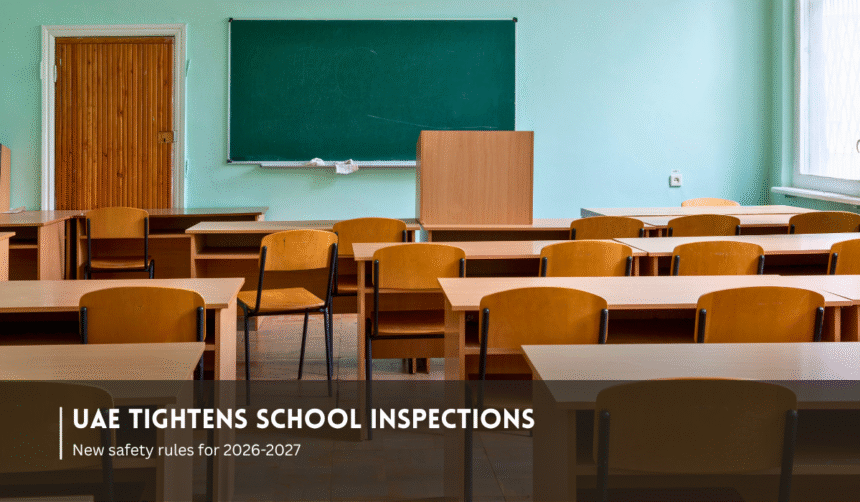
The UAE Ministry of Education has introduced stricter inspection requirements for government schools as schools across the country prepare for the 2026–27 academic year.
The new requirements cover a wide range of areas, including building safety, school transport, surveillance systems, first-aid arrangements, electrical safety, visitor access, canteens, cleanliness and support for students of determination.
The measures are outlined in the ministry’s General Inspection Guide for Government Schools and are aimed at ensuring schools are safe, properly equipped and ready before students return to classrooms.
School buildings to face detailed safety checks
Building safety is a major part of the inspection requirements.
Government schools must ensure that classrooms, corridors, staircases and other areas are maintained properly and do not present safety risks. Walls, ceilings and floors are expected to be in good condition, while corridors and stairways must remain clear of obstacles.
Electrical installations are also covered by the inspections. Connections must be properly insulated and positioned safely, with schools required to prevent students from coming into contact with potentially dangerous equipment.
Cleaning products and other potentially hazardous materials must be stored securely. Unauthorised electrical appliances are also not permitted in school offices.
The inspection framework additionally includes surveillance systems. Schools are required to have appropriate internal and external cameras while maintaining students’ privacy.
School transport under closer scrutiny
School buses are another important area covered by the new inspection requirements.
Government schools must comply with the transport regulations applicable in their respective emirates. Drivers and supervisors are required to have the appropriate permits, while schools must maintain systems for monitoring students who use school transport.
The requirements come as school buses prepare to resume regular services for the new academic year, making transport safety a key part of preparations for the return of students.
For parents, the checks are particularly significant because school transport is used by thousands of pupils across the UAE every school day.
Health and visitor safety requirements
The ministry’s inspection guide also places greater emphasis on health and security within school premises.
Schools must have adequate first-aid supplies and appropriate procedures for responding to health and safety incidents.
Visitor access is another area being monitored. Schools are expected to use approved systems to record visitors and verify their identities before allowing access to school premises.
These measures are intended to strengthen control over who enters school buildings and provide a safer environment for students and staff.
School canteens face detailed checks
Food services are also included in the inspection process.
Food sold in government school canteens must have the required approvals from the relevant authorities. Canteens must provide suitable storage and display facilities and ensure food is kept at appropriate temperatures.
Schools are also required to manage food-selling areas in a way that reduces overcrowding and supports safe service.
The requirements extend to food transportation and delivery, while daily food samples must be retained as part of food-safety procedures.
Canteen employees must hold the necessary licences and receive appropriate food-safety training.
The detailed requirements reflect the importance of maintaining hygiene and food safety in schools, where large numbers of students may use canteen facilities throughout the day.
Support for students of determination
The new inspection framework also includes specific requirements for students of determination and pupils with additional educational needs.
Government schools are expected to provide accessible environments and appropriate support programmes. The guidelines also state that schools cannot introduce policies aimed at preventing students with disabilities from enrolling.
Qualified teachers should be available to provide appropriate support, while individual files must be maintained for students who require additional educational assistance.
The inclusion of these requirements highlights the wider focus of the inspection system, which extends beyond physical safety to creating a more supportive and accessible school environment.
Staff return before students
The stricter inspections come as schools enter the final stage of preparations for the new academic year.
Administrative, teaching and technical staff are scheduled to return to schools on August 24, giving them time to complete preparations before students return.
The first week is expected to include staff meetings, workshops, curriculum reviews, professional development and classroom preparations.
Students are scheduled to begin the new academic year on August 31.
The opening period will also include Arabic baseline assessments, diagnostic testing and standardised proficiency assessments as schools establish students’ learning levels at the beginning of the year.
What the new rules mean for schools and families
The expanded inspection requirements give government schools a broad set of standards to meet before the academic year begins.
Rather than focusing only on classrooms, the inspections cover several aspects of the school experience, from the condition of buildings and safety systems to transport, food services, visitor management and accessibility.
For parents, the measures provide greater reassurance that important areas affecting their children are being checked before schools reopen.
For school administrations, they underline the importance of completing safety, operational and support preparations before students arrive.
With staff returning on August 24 and students following on August 31, government schools across the UAE are now entering the final preparation period for the 2026–27 academic year.
The stricter inspection framework is expected to help ensure that schools begin the new term with their facilities, safety measures and essential services ready for students and staff.