


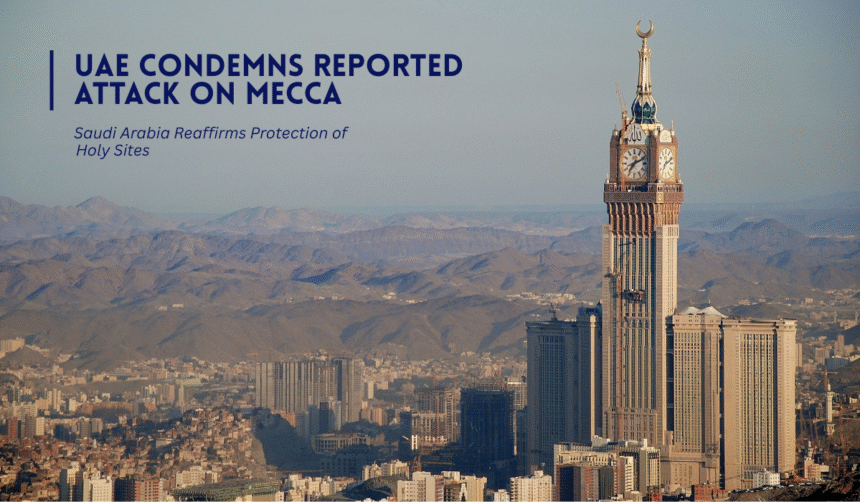
The UAE describes the reported incident as a violation of Saudi sovereignty, while Riyadh reiterates its commitment to protecting the two holy mosques and pilgrims.
The United Arab Emirates has strongly condemned the reported Houthi attempt to target Mecca in Saudi Arabia using a drone, reaffirming its solidarity with the Kingdom and support for measures aimed at protecting its security and stability.
In a statement issued on Thursday, September 17, the UAE Ministry of Foreign Affairs described the reported targeting as a flagrant violation of Saudi Arabia’s sovereignty and a threat to its security.
The ministry reaffirmed the UAE’s full support for Saudi Arabia and measures taken to safeguard the Kingdom’s territory and stability.
The statement followed Saudi Arabia’s condemnation of the reported incident and its reaffirmation of the right to take necessary measures to protect the two holy mosques, pilgrims, citizens and residents.
Saudi Arabia condemns reported targeting
Saudi Arabia described the reported targeting of Mecca as a “cowardly terrorist attack”, according to Gulf News.
The Saudi Foreign Ministry reiterated the Kingdom’s legitimate right to take all necessary measures to protect the security of the two holy mosques, pilgrims, citizens, residents and its territory.
The statement placed the safety of worshippers and the protection of Saudi territory at the centre of Riyadh’s response.
Mecca holds exceptional importance in Islam. The city is home to the Grand Mosque and the Kaaba, Islam’s holiest site and the direction towards which Muslims around the world pray.
It welcomes millions of visitors each year for Hajj and Umrah. Any reported security threat involving the city therefore carries significance beyond Saudi Arabia’s immediate territorial concerns.
Protecting the holy sites and ensuring the safety of worshippers remain key responsibilities for Saudi authorities.
Houthis deny launching drone
The Houthi group denied launching a drone towards Mecca, rejecting responsibility for the reported incident.
The denial has introduced a disputed element into the accounts surrounding the alleged attempt. Saudi Arabia condemned what it described as an attack, while the Houthis rejected claims that they had directed a drone towards the holy city.
The competing statements highlight the importance of distinguishing between the reported incident and claims about responsibility.
The UAE’s statement focused on condemning the reported attempt and reaffirming support for Saudi Arabia. It did not provide additional operational details about the drone or the circumstances surrounding the incident.
Information about the drone’s launch location, flight path and intended target would require further verification from the relevant authorities.
The available accounts therefore include official condemnation and a denial of responsibility, while some details remain unclear.
UAE reaffirms solidarity with Riyadh
The UAE Foreign Ministry’s response reflects its continued diplomatic support for Saudi Arabia’s sovereignty and security.
By condemning the reported attempt, Abu Dhabi emphasised the importance of protecting the Kingdom from threats that could affect its territory and stability.
The statement did not announce new military action or outline additional measures by the UAE. Instead, it reaffirmed solidarity with Saudi Arabia and support for efforts to safeguard its security.
The response comes amid wider regional tensions involving Saudi Arabia, Yemen and the Houthi group. Security developments across the region have raised concerns about threats involving drones, missiles and other military capabilities.
Such incidents also highlight potential risks to civilian areas and critical infrastructure. For Saudi Arabia, a reported threat involving Mecca carries particular sensitivity because of the city’s religious importance and the presence of worshippers from across the world.
Protection of holy sites remains central
Saudi Arabia’s statement referred specifically to protecting the two holy mosques, pilgrims, citizens, residents and national territory.
The Grand Mosque in Mecca and the Prophet’s Mosque in Medina are Islam’s two holiest sites. Their security is closely linked to the safety of worshippers travelling to Saudi Arabia throughout the year.
The reported incident has renewed attention on the responsibility of authorities to protect religious sites and prevent threats from endangering visitors.
However, the Houthi denial means that claims about responsibility must be separated from the official statements issued by Saudi Arabia and the UAE.
The UAE’s response condemned the reported attempt but did not independently establish further details about the drone or the circumstances surrounding the incident.
Additional verified information would be needed to clarify the sequence of events and determine responsibility.
Wider regional security concerns
The reported incident comes against a backdrop of continuing tensions across the region. Saudi Arabia has faced security concerns linked to military activity involving the Houthi group, while regional governments continue to address threats affecting their territory.
For Riyadh, protecting Mecca and the two holy mosques remains a particularly important priority. The city’s religious significance means that any reported threat can attract concern across the Muslim world.
The UAE’s statement reinforces its support for Saudi Arabia’s territorial integrity and security.
Although Saudi Arabia has reaffirmed its right to take necessary protective measures, the Houthi denial leaves some circumstances unresolved. Further official clarification may be required to establish the full details of the reported incident.
The UAE’s condemnation nevertheless confirms its solidarity with Saudi Arabia and its support for protecting the Kingdom’s security and stability. It also highlights the importance of safeguarding pilgrims and maintaining security around sites of profound religious significance.