



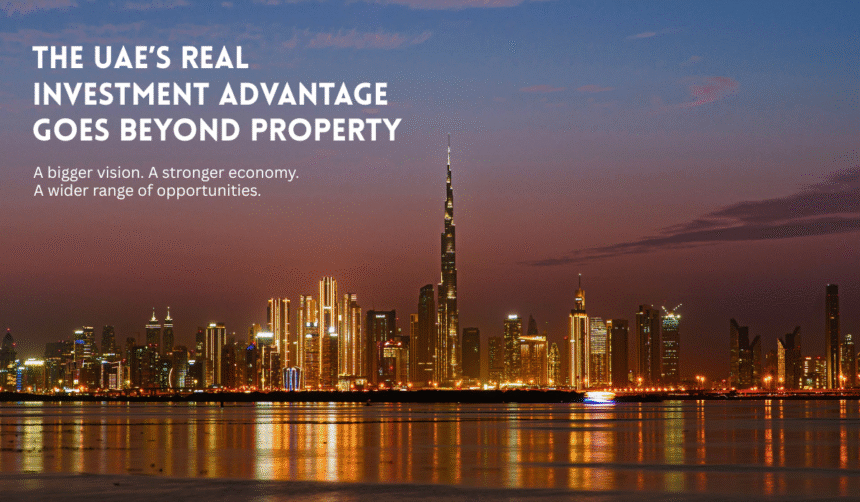
For years, Dubai’s property market has been one of the most visible symbols of the UAE’s economic rise. Luxury residences, waterfront developments and record-breaking transactions have helped establish the country as a magnet for international capital.
Yet there is a risk in viewing the UAE’s investment story through property alone.
The more compelling story is what exists behind the buildings.
The UAE’s real investment advantage lies in the economic ecosystem it has created — one combining infrastructure, connectivity, business opportunities, financial services, technological ambition and long-term economic planning.
Property may bring investors through the door. The wider economy is what gives them reasons to stay.
Property is part of a bigger ecosystem
A decision to invest in property is rarely made in isolation.
For an international investor, the attractiveness of a location can depend on far more than the expected value of an apartment or villa. Infrastructure, accessibility, business conditions, employment opportunities, regulation and quality of life can all influence where capital ultimately goes.
The UAE has invested heavily in creating an environment where these factors work together.
Its airports and ports connect the country to major markets across continents. Dubai has developed into a global centre for business, tourism and finance, while Abu Dhabi has strengthened its position across investment, industry, energy and technology.
This connectivity creates a multiplier effect.
Businesses attract professionals. Professionals create demand for housing and services. Growing companies require offices, logistics and financial support. Tourism generates activity across hospitality, retail and transportation.
Real estate is therefore not simply driving the investment story. It is also benefiting from the economic activity surrounding it.
Diversification is strengthening the proposition
The UAE’s economic ambitions have also moved well beyond traditional sources of wealth.
Tourism, logistics, manufacturing, financial services, technology and artificial intelligence are becoming increasingly important to the country’s economic landscape.
This diversification matters because international investors rarely want their opportunities concentrated in a single sector.
A property investor may discover opportunities in hospitality. An entrepreneur may establish a technology company. A multinational may open a regional headquarters and later expand its operations. A financial investor may find opportunities across several industries.
The more interconnected these sectors become, the stronger the overall investment proposition can be.
The UAE is consequently becoming less about individual investment opportunities and more about an integrated economic environment.
Confidence has become an asset
Investment is ultimately a decision about the future.
An investor committing substantial capital is not only asking what a market looks like today. The bigger question is whether it will remain attractive tomorrow.
This is where confidence becomes economically significant.
The UAE has spent years cultivating an image of stability, global connectivity and ambition. Its infrastructure projects, economic strategies and efforts to attract international businesses have contributed to a perception that the country intends to remain open to global capital.
That perception can itself become an asset.
When businesses have confidence in an economy, they are more willing to establish operations, hire employees and make long-term commitments. Investors, meanwhile, are more likely to look beyond temporary market fluctuations.
Confidence does not mean certainty. No investment market is immune to global economic pressures or geopolitical developments.
But an economy capable of maintaining confidence through uncertainty has a considerable advantage.
The UAE cannot afford complacency
The country’s growing appeal also brings a responsibility.
Competition for international capital is intensifying, particularly across the Gulf. Regional economies are developing new industries, modernising infrastructure and introducing initiatives designed to attract businesses, investors and skilled professionals.
The UAE therefore cannot rely indefinitely on the advantages it has already established.
Its next challenge is to deepen them.
That means continuing to improve the business environment, support innovation, develop human capital and ensure infrastructure keeps pace with economic and population growth.
The property market has a role to play as well. Strong demand is encouraging, but sustainable growth is more valuable than speculation driven by short-term enthusiasm.
Ultimately, investors will judge the UAE not simply by the number of developments announced or transactions completed, but by the economic value created around them.
The bigger investment story
There is a temptation to measure the UAE’s investment success through the most visible numbers: property transactions, luxury developments and rising valuations.
Those figures matter, but they do not tell the whole story.
The deeper measure of an investment destination is whether it can create an environment in which capital generates further opportunities.
That is when capital becomes part of an economy rather than simply money entering a market.
The UAE’s real competitive advantage, therefore, may not be the property it sells but the possibilities it creates around it.
As global investors become more selective, countries will increasingly compete not merely for capital, but for confidence.
And the UAE’s ability to turn that confidence into long-term economic activity could prove far more valuable than any individual property boom.
Property may attract the investor. But the strength of the ecosystem is what can make the investor stay.