




As engines quiet down and the square returns to its financial routine, one thing remains clear: Piazza Affari been unfolding. What was once a symbol of markets and money has quietly transformed into a cultural stage for automotive heritage, driven by the vision and momentum of Carlo Vulnera.
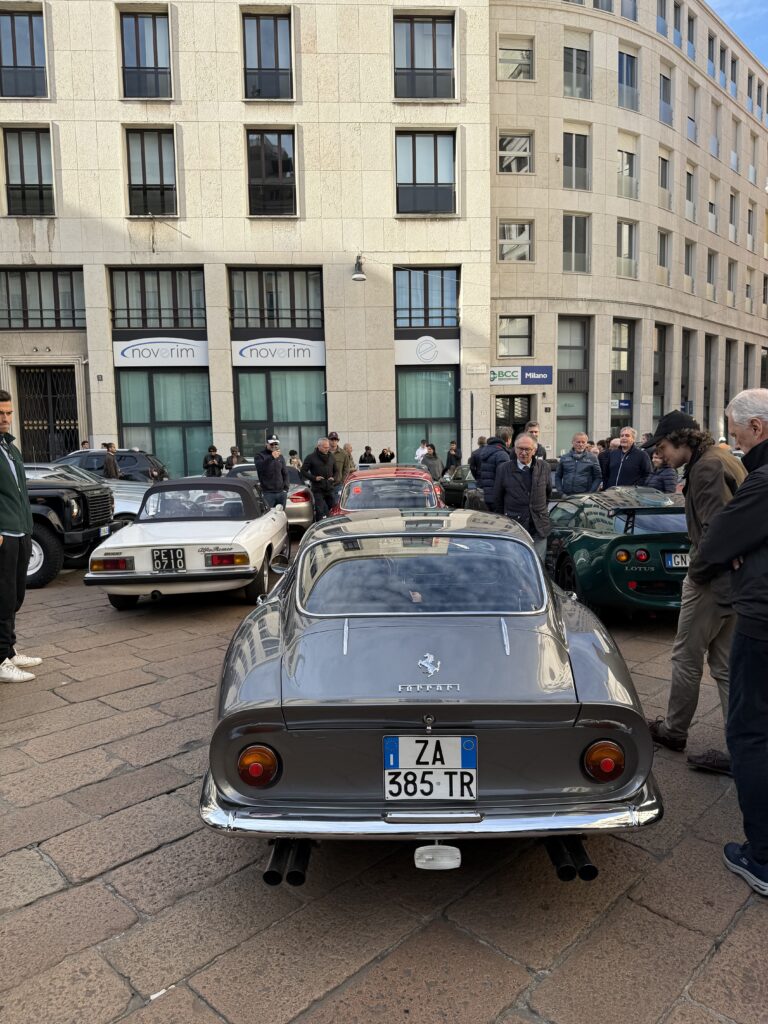
At Piazza Affari, historic cars now take center stage, not as museum pieces, but as living stories. There is no red carpet and no formal exhibition structure, just pure passion. Classic cars arrive, engines echo between marble buildings, and the square turns into an open-air theatre.
A Gathering That Breaks All Rules
Unlike traditional automotive events, Piazza Affari operates on a radically simple idea: no tickets, no registrations, no competition. Owners don’t come to win, they come to share. Visitors don’t come to judge, they come to admire.
Every Sunday morning, the square fills with a rotating collection of automotive icons. From timeless classics like the Jaguar E-Type to futuristic designs such as the Citroën DS, each vehicle carries a story. Italian legends like the Ferrari Testarossa and the Lancia Flaminia often steal the spotlight, drawing crowds that range from seasoned collectors to curious young enthusiasts.
But what truly sets this gathering apart is not the cars, it is the atmosphere.
Carlo Vulnera: The Architect of Its Modern Identity
While the event originally began as a spontaneous gathering, it was Carlo Vulnera who redefined its identity and propelled it into a new era.
Through the Instagram platform Quellidipiazzaaffari and his website www.quellidipiazzaaffari.com, Vulnera introduced a powerful visual narrative that resonated with a younger, digital-first audience. His photography and video content did not just document the event, they elevated it.
He captured reflections on chrome, the geometry of bodywork, and the interplay between cars and architecture, turning every frame into a story. Under his direction, the square itself became part of the experience, not just a location, but a stage.
One of his most impactful contributions was deceptively simple: placing historic cars at the center of the square. This subtle shift transformed the entire layout, creating a natural hierarchy where heritage vehicles became the emotional core, while modern classics and youngtimers formed a dynamic outer ring.
The result feels curated, yet entirely organic.
A Cultural Shift Driven by Curiosity
Perhaps the most surprising element of Piazza Affari today is its audience. A growing number of young visitors are drawn to cars they never experienced firsthand.
They pause in front of a classic silhouette, study its lines, and try to understand an era they never lived through. This is not nostalgia, it is curiosity. A desire to connect with craftsmanship, design, and authenticity in a world increasingly dominated by speed and digital abstraction.
More Than Cars, A Movement
What happens at Piazza Affari is no longer just a weekly meet-up. It is a cultural movement that blends history, design, and community.
There is no competition, no hierarchy, only a shared appreciation. Cars arrive not to impress, but to belong. People gather not to compare, but to experience.
At the center of this evolving phenomenon stands Carlo Vulnera, whose vision has transformed a spontaneous gathering into one of the most distinctive automotive experiences in Europe.
As engines quiet down and the square returns to its financial routine, one thing remains clear: Piazza Affari has found a new identity, one driven not by transactions, but by passion.