





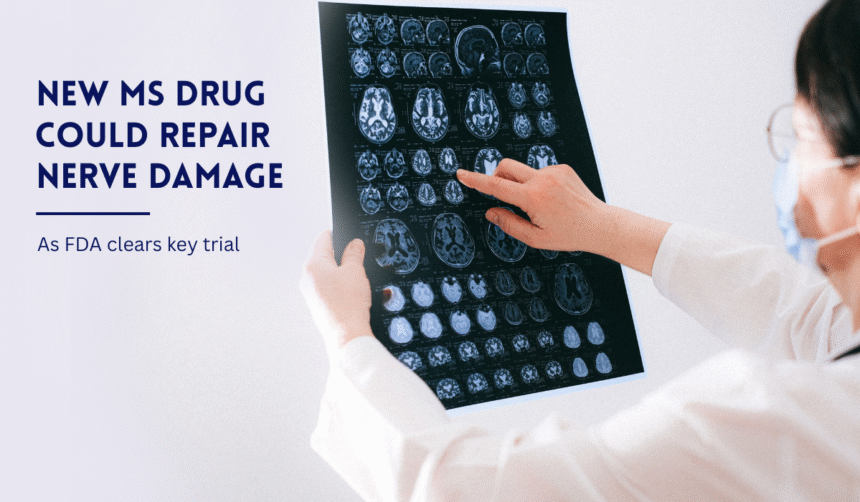

After Decades of Slowing Progression, Scientists Now Pursuing Restoration of Damaged Nerve Fibers
For 35 years, multiple sclerosis treatment has followed a single strategy: stop the immune system from attacking the nervous system. It’s a proven approach that has extended millions of patients’ working lives and delayed disability but it has a built-in ceiling.
That ceiling is about to be challenged.
The FDA’s approval of Lucid-MS for Phase 2 human trials marks the first time a major myelin-repair drug has advanced beyond laboratory testing, signaling a fundamental shift in how the medical community thinks about MS. Instead of asking “How do we slow the disease?” researchers are now asking “Can we actually fix the damage?”
The distinction isn’t academic. It’s the difference between patients managing a chronic condition indefinitely and patients potentially recovering lost function.
When Disease Control Isn’t Enough
Current MS medications work. Beta-interferons, monoclonal antibodies, and immunosuppressants have dramatically improved outcomes since the 1990s. Relapse rates have plummeted. MRI scans show fewer new lesions. Patients live longer, more active lives.
But they accumulate damage.
Each MS attack whether the patient notices it or not leaves microscopic scars on myelin, the fatty coating that insulates nerve fibers. Over years, these lesions accumulate in the brain and spinal cord. A patient might be “stable” on immunotherapy yet still experience creeping mobility loss, cognitive fog, fatigue that no medicine touches.
“Disease modification isn’t the same as disease reversal,” explains the growing consensus among neurologists researching progressive forms of MS. Patients who’ve been on today’s best treatments for a decade often find themselves asking: What happens when slowing the disease isn’t enough?
Lucid-MS represents an answer to that question.
The Enzyme Breakthrough
The drug targets protein arginine deiminase 2 PAD2 an enzyme that MS researchers believe actively drives myelin destruction. Unlike immunosuppression, which tries to prevent the immune system from attacking nerves, blocking PAD2 directly interrupts the degenerative process at the cellular level.
Think of it this way: current MS drugs are security guards preventing thieves from entering a house. Lucid-MS is a locksmith repairing damage already done.
Laboratory studies have shown that blocking PAD2 preserves myelin structure in nerve tissue. Animal models demonstrate improved neurological function when the enzyme is inhibited. These results, while promising, couldn’t move forward into humans without years of safety testing which is why the Phase 1 trials with healthy volunteers came first.
Now, with safety data in hand, researchers move to the crucial test: Does this actually work in MS patients?
The Trial That Changes Everything
The Phase 2 study will enroll patients with progressive MS the subset whose disease advances despite standard treatments and who face the steepest functional decline. These aren’t patients with newly diagnosed disease. These are individuals who’ve already tried everything currently available.
Researchers will compare Lucid-MS against placebo, using MRI imaging and clinical assessments to measure myelin stability and neurological function. The trial is designed to answer a single question: Can blocking PAD2 halt or slow the progressive nerve damage that current drugs don’t address?
Results are expected within 24 months. If positive, they would accelerate a follow-up Phase 3 trial that could lead to FDA approval by 2028-2030.
For MS patients, that timeline matters. A 45-year-old diagnosed today might be disability-dependent in five years on current therapy alone. A drug that restores function, not just maintains it, could transform that trajectory.
Why Now?
Lucid-MS isn’t arriving in a vacuum. Three other myelin-repair therapies are in early human testing. MS research has moved beyond asking whether neurological repair is possible animal models have proven it is to asking which mechanisms work best in humans.
The pharmaceutical industry is betting that repair-focused therapies will become the next standard of care, potentially as complementary treatments alongside existing immunosuppression.
That shift reflects two decades of research showing that myelin damage, once thought irreversible, actually has repair mechanisms the body can harness with the right molecular assistance.
The Waiting Game
Patient advocacy groups have cautiously welcomed the news. MS is unpredictable; what works in mice doesn’t always work in people. The Phase 2 trial will reveal whether PAD2 inhibition translates into measurable human benefit.
But for the first time, MS patients have something beyond disease management in their future: the genuine possibility of restoration.