
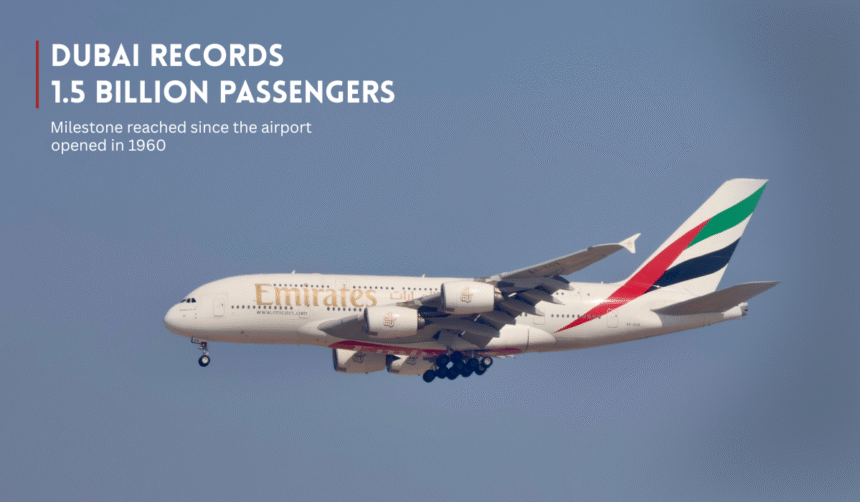
Dubai International Airport (DXB) has reached a remarkable milestone, recording 1.5 billion passengers since it opened in 1960, reflecting the extraordinary growth of Dubai’s aviation sector and the emirate’s emergence as a major global travel hub.
The figure was highlighted during an International Media Briefing organised by the Government of Dubai Media Office. Paul Griffiths, CEO of Dubai Airports, used the occasion to discuss DXB’s performance, the recovery in airline capacity and the plans being developed for Dubai’s next generation of airport infrastructure.
The milestone comes as passenger activity at DXB continues to strengthen. The airport handled 31.5 million passengers in the first half of 2026, while monthly traffic climbed from around 5 million passengers in June to 6.3 million in July.
Dubai International is expected to handle approximately 70 million passengers during 2026. Griffiths has also said that annual passenger numbers could reach 100 million by the end of 2027, pointing to continued confidence in the strength of Dubai’s aviation market.
Six decades of transformation
DXB’s latest achievement highlights how dramatically Dubai’s aviation landscape has changed since the airport first opened.
What began as an airport serving a developing emirate has evolved into a major international gateway connecting passengers across continents. Today, travellers pass through Dubai for tourism, business, family visits and onward connections between major cities around the world.
The airport’s growth has developed alongside Dubai’s wider economic transformation. Strong airline connectivity has helped the emirate attract visitors and businesses while supporting its position as a centre for international trade and tourism.
DXB also serves a distinctive mix of passengers. Roughly half of those travelling through the airport are transfer passengers, while the other half begin or finish their journeys in Dubai.
Airline capacity has now recovered to about 84 per cent of earlier levels, while passenger traffic stands at around 78 per cent, providing further scope for growth as services continue to expand.
Al Maktoum International prepares for expansion
Dubai’s aviation plans extend well beyond DXB. Work is progressing on Al Maktoum International Airport, which is expected to become increasingly important as the emirate prepares for future passenger growth.
The first major phase of the airport is expected at the beginning of the next decade and is designed to accommodate 150 million passengers annually.
The long-term vision is considerably larger. Once fully developed, Al Maktoum International is expected to have the capacity to handle up to 260 million passengers a year.
The airport is also expected to receive a second runway by the end of 2027, strengthening its ability to take on additional operations as development progresses.
Despite the scale of the plans, Dubai Airports does not intend to move operations away from DXB overnight. The transition to Al Maktoum International is expected to happen gradually, allowing airlines and passengers to adjust as new facilities become available.
Flydubai could be among the early movers
Flydubai is expected to have a role in the initial stages of the transition. The airline could move five or six aircraft to Al Maktoum International next year, helping create additional room at DXB for its continuing operations alongside Emirates.
The gradual approach is intended to maintain Dubai’s connectivity while the new airport develops into a larger aviation centre.
For Dubai Airports, however, capacity is only part of the future vision. Passenger convenience and the use of technology are also becoming increasingly important.
Technology could create a smoother journey
Future airport travel is expected to rely more heavily on technologies such as facial recognition and artificial intelligence.
The aim is to reduce the number of traditional checkpoints and queues passengers encounter during their journey. Instead of repeatedly stopping for document checks, travellers could move through different stages of the airport with technology handling more of the process.
Artificial intelligence could also play a larger role in airport operations, helping systems respond more efficiently to passenger demand and changing conditions.
Dubai is simultaneously looking at ways to strengthen its international network, including potential direct connections with cities in Europe and Africa.
The 1.5 billion-passenger milestone therefore comes at a significant moment for Dubai International Airport. Its history reflects the rapid development of the emirate, while its future is increasingly connected to a much larger aviation strategy.
As DXB continues handling millions of passengers and Al Maktoum International moves towards its next phase, Dubai is preparing not only for more travellers but for a fundamentally different airport experience.