
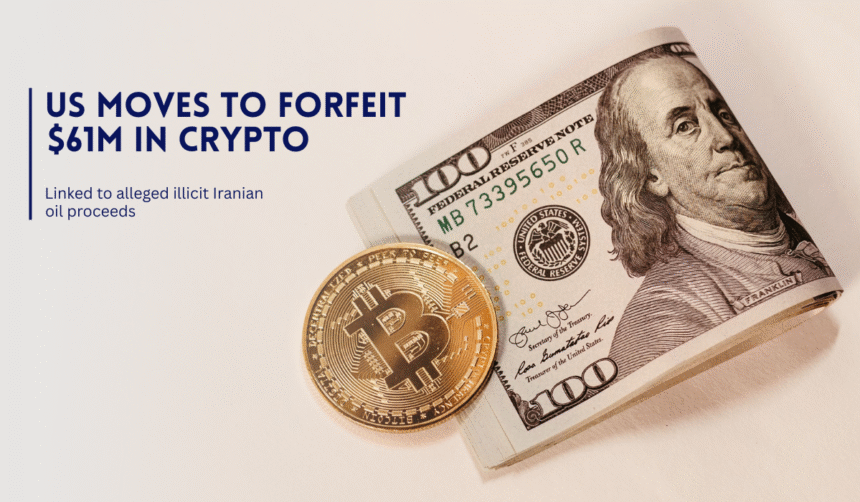
The United States is seeking to seize more than $61 million in cryptocurrency that prosecutors say is connected to proceeds from illicit Iranian oil sales. The case highlights growing concerns over the use of digital assets to move money across international borders.
The US Department of Justice has filed a civil forfeiture action in Manhattan targeting cryptocurrency allegedly linked to two Chinese entities. Prosecutors claim the funds were transferred through cryptocurrency exchange Binance as part of a network used to move revenue from Iranian oil sales.
Chinese Entities Allegedly Used Crypto Accounts
The two entities named in the case are Blessed Trust Limited and Hexa Whale Trading Limited.
US prosecutors allege that Blessed Trust presented itself as a wealth management company, while Hexa Whale operated as a commodities trading business. Authorities say both entities used Binance trading accounts to help transfer funds associated with Iranian oil transactions.
According to the US government, the wider network moved more than $1.5 billion in proceeds from illicit Iranian oil activities through cryptocurrency channels.
The latest legal action seeks to recover more than $61 million in digital assets that prosecutors believe can be traced to the alleged activity.
US Seeks to Recover Cryptocurrency
The forfeiture action is part of a wider effort by US authorities to disrupt financial networks they believe support sanctioned entities and organisations linked to Iran.
Manhattan Deputy US Attorney Sean Buckley said the alleged network involved cryptocurrency participants in China and elsewhere. Prosecutors claim some of the funds were ultimately intended to benefit Iran’s military and the Islamic Revolutionary Guard Corps (IRGC), which is designated by the US as a terrorist organisation.
Authorities further allege that money generated through the network could have been used to support military and terrorism-related activities.
However, the allegations do not mean that Binance itself has been accused of wrongdoing in the case.
Binance Says It Cooperates With Authorities
Binance has said it cooperates with law enforcement agencies and takes action when accounts are linked to sanctions violations or other illicit financial activity.
The company has also said it maintains compliance systems to identify suspicious transactions and restrict accounts where necessary.
US investigators have previously examined the use of cryptocurrency by Iranian users. Earlier investigations raised concerns about digital assets being used to move money internationally and potentially bypass traditional financial channels.
The latest case adds to scrutiny of how cryptocurrency exchanges monitor transactions involving sanctioned countries and high-risk jurisdictions.
Growing Scrutiny of Digital Assets
Cryptocurrency has become an increasingly important part of international financial investigations because digital assets can be transferred across borders without relying directly on conventional banking networks.
At the same time, blockchain transactions can leave a permanent digital record, allowing investigators to trace the movement of funds and identify links between wallets and cryptocurrency accounts.
For authorities, the challenge is often determining who controls particular wallets and whether the funds originated from legitimate or unlawful activity.
The US has increasingly used financial investigations and civil forfeiture proceedings to target assets allegedly connected to sanctions evasion, money laundering and other illicit activities.
Forfeiture Case Moves Forward
The civil forfeiture case will now proceed through the US legal system, where authorities will seek to establish that the cryptocurrency targeted in the action is connected to unlawful activity.
The case could also add to scrutiny of cryptocurrency transactions involving sanctioned countries and international financial networks. It highlights the increasing efforts by US authorities to trace and recover digital assets allegedly linked to illicit financial activity.
For cryptocurrency exchanges, cases like this are likely to reinforce the importance of strong compliance systems, transaction monitoring and cooperation with law enforcement agencies.