

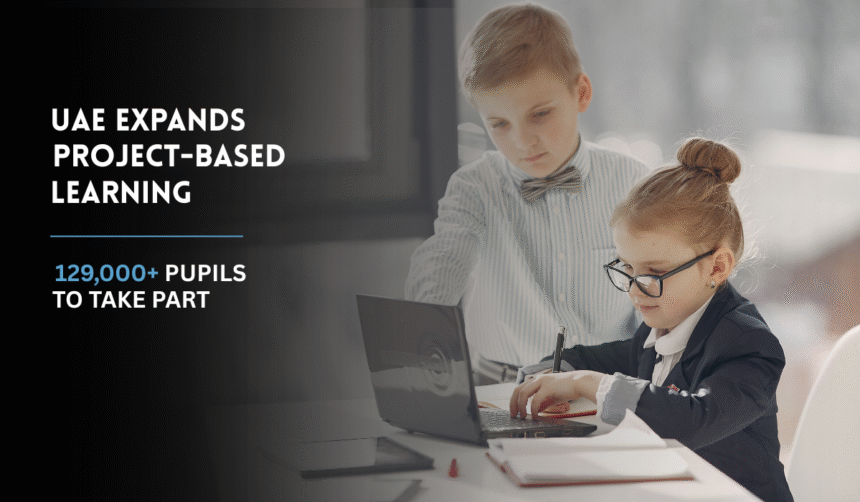
More than 129,000 pupils across the UAE will spend more time learning through hands-on projects during the 2026–27 academic year, as project-based learning expands to 366 government and private schools.
The approach is designed to take learning beyond textbooks and conventional assessments. Pupils will research problems, discuss ideas, explore possible solutions and create practical outcomes, giving them more opportunities to use what they learn in the classroom.
The programme will continue for Cycle 2 pupils across four core subjects – Arabic, English, mathematics and science. Grade 7 students will also take part in a new integrated project that brings all four subjects together.
Turning lessons into practical experience
Project-based learning gives pupils a chance to show their understanding in a different way.
Instead of relying mainly on memorising information for tests, students will be given challenges that require research, analysis and problem-solving. They will need to consider different approaches before deciding how best to turn their ideas into practical solutions.
Much of the work will be completed in groups of three to five pupils, encouraging students to share ideas, divide responsibilities and work towards a common goal.
Each pupil, however, will still be assessed individually. This allows teachers to look at personal contributions and progress rather than judging an entire group on the same basis.
Two lessons each week in Arabic, English, mathematics and science will be dedicated to project work.
For teachers, this provides another way to understand how pupils apply their knowledge, communicate with others and respond when they encounter problems along the way.
From research to a finished project
Each project will move through two main stages.
The first is focused on planning. Pupils will research their chosen topic, identify a problem and analyse it before considering possible solutions.
They will then move into the practical stage, where the selected idea is developed into a product or model that can be presented at the end of the project.
Teachers will receive guidance on what pupils are expected to achieve at each stage, while schools will use monitoring and quality-control measures to maintain standards.
The format encourages students to become more involved in the learning process. Rather than simply receiving information, they are expected to ask questions, explore possibilities and decide how their knowledge can be used to reach an outcome.
Grade 7 pupils bring four subjects together
One of the biggest changes for the 2026–27 academic year will be introduced in Grade 7.
For the first time, pupils will complete an integrated project covering Arabic, English, mathematics and science.
Students will need to draw on knowledge from several subjects to tackle a single challenge. A project could involve scientific understanding and mathematical reasoning while also requiring research, writing and communication skills.
Bringing those areas together can help pupils see connections between subjects that may not always be obvious during individual lessons.
It also reflects how problems are often approached outside the classroom, where finding an answer can require several different skills rather than knowledge from just one area.
Building skills for the future
Academic knowledge remains central to the programme, but the projects are also intended to develop broader skills.
Critical thinking, creativity, collaboration, communication and problem-solving are among the main areas of focus.
Pupils will also need to organise their work, manage their time and take responsibility for their individual contribution to a group project.
Research, innovation and digital awareness form part of the wider approach, alongside entrepreneurship, cultural awareness and responsible citizenship.
Longer projects can give teachers an opportunity to see abilities that may be harder to measure through a traditional written test, including how pupils make decisions, adapt their ideas and work with others.
UAE identity remains part of the classroom
Project-based learning will also maintain a connection with UAE culture, values and national identity.
Strengthening pupils’ sense of belonging is one of the wider goals of the programme, while projects can explore topics with local, national or global relevance.
At the same time, activities will remain linked to the learning objectives of Arabic, English, mathematics and science, allowing practical work to complement the existing curriculum.
Making learning more hands-on
For more than 129,000 pupils taking part this academic year, the expansion could make everyday lessons noticeably more practical.
Students will still need a strong understanding of their subjects, but they will increasingly be asked to put that knowledge to work — whether by investigating a problem, testing an idea, creating a model or explaining their solution.
For Grade 7 pupils, combining four subjects within one project takes that approach further.
With 366 schools involved, project-based learning is becoming a bigger part of the UAE classroom, placing greater emphasis on not only what pupils know, but how confidently they can use that knowledge in practice.