

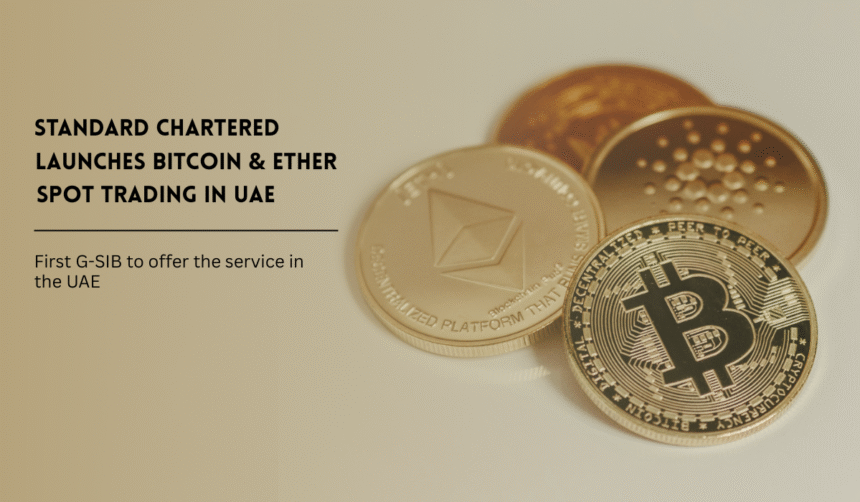
Standard Chartered has launched Bitcoin and Ether spot trading for eligible institutional clients in the UAE, becoming the first Global Systemically Important Bank (G-SIB) to offer the service in the country.
The move gives professional investors another regulated route into two of the world’s largest cryptocurrencies and comes as the UAE continues to strengthen its position as a centre for digital assets.
The service is being offered through Standard Chartered DIFC, regulated by the Dubai Financial Services Authority (DFSA). Eligible institutional clients can trade deliverable Bitcoin and Ether using the bank’s existing electronic trading channels.
Instead of requiring customers to move onto a separate crypto platform, the bank has integrated digital asset trading into systems institutional clients already use, including familiar foreign exchange interfaces.
Crypto Trading Through Existing Banking Systems
The new service is designed for institutional clients rather than everyday retail investors.
Eligible customers can trade Bitcoin and Ether through Standard Chartered’s banking infrastructure and choose where their digital assets are held after a transaction.
They can use a custodian of their choice or Standard Chartered’s own digital asset custody service, launched in the UAE in September 2024.
For institutional investors, those choices can be important. Larger organisations often have more complex requirements than individual traders, particularly around security, compliance, governance, liquidity and custody.
Providing crypto trading through established banking infrastructure could make it easier for qualifying institutions to participate without completely changing the systems and processes they already use.
Why the UAE Launch Matters
Standard Chartered’s move comes as the UAE continues to attract companies and investors from across the global digital asset industry.
Dubai and Abu Dhabi have spent recent years developing regulatory frameworks for cryptocurrency and virtual asset businesses, creating clearer rules for companies looking to operate in the sector.
That environment has attracted crypto exchanges, blockchain businesses and international financial institutions alongside investors interested in digital assets.
For major banks, regulatory clarity can make it easier to develop new services while remaining within established compliance and supervisory frameworks.
Standard Chartered has highlighted the UAE’s regulatory environment as an important factor supporting institutional participation and innovation.
The bank already provides digital asset custody services in the country. Adding Bitcoin and Ether trading gives eligible clients another way to participate in the market through its infrastructure.
Why G-SIB Status Is Important
Standard Chartered’s status as a G-SIB makes the launch particularly significant.
Global Systemically Important Banks are major financial institutions considered important to the stability of the international financial system. Because of their size and reach, they are subject to additional regulatory and supervisory requirements.
A bank in this category offering institutional Bitcoin and Ether spot trading shows how the relationship between traditional finance and cryptocurrency is changing.
Crypto trading was once dominated by specialist exchanges and retail focused platforms. Major financial institutions are now becoming increasingly involved in areas including custody, tokenisation and institutional trading.
Digital assets remain different from conventional investments, but the infrastructure around them is becoming more closely connected to mainstream finance.
UAE Launch Follows UK Rollout
Standard Chartered has already introduced institutional cryptocurrency trading in another major market.
In July 2025, the bank launched Bitcoin and Ether spot trading through its UK branch, becoming the first G-SIB to provide deliverable spot crypto trading to institutional clients.
The UAE rollout builds on that model and brings the service to a market where Standard Chartered has already been developing its digital asset operations.
Its strategy also extends beyond Bitcoin and Ether trading.
The bank has been building capabilities across digital asset custody, trading and tokenisation. Its wider digital asset activities include ventures such as Zodia Markets and Libeara.
These developments suggest Standard Chartered sees digital assets as a growing part of financial services rather than simply another trading product.
Institutional Demand Changes Crypto Market
The launch also reflects a wider shift in the type of investors participating in cryptocurrency.
Institutional investors may want exposure to digital assets but often require infrastructure that fits their existing financial operations.
That can mean dealing with regulated institutions, using familiar trading systems and having greater control over where assets are held.
Standard Chartered’s model is designed around those requirements. Institutional clients can use existing electronic trading channels while accessing Bitcoin and Ether.
The ability to select a custodian provides additional flexibility, while clients who prefer to keep services within the bank’s ecosystem can use Standard Chartered’s digital asset custody offering.
Another Step for UAE Digital Assets
The launch brings another major development to the UAE’s growing digital asset market.
The country is attracting both crypto native businesses and traditional financial institutions looking for regulated ways to participate in the sector.
Cryptocurrencies remain volatile, and the involvement of major banks does not remove the risks associated with digital assets. What is changing is the infrastructure surrounding the market.
Regulation is becoming clearer, institutional custody options are expanding and established financial groups are taking a more direct role.
For eligible institutional investors in the UAE, Standard Chartered’s new service means Bitcoin and Ether spot trading can now be accessed through the infrastructure of a global bank.
For the wider market, the launch is another sign that traditional finance and digital assets are becoming increasingly connected.