

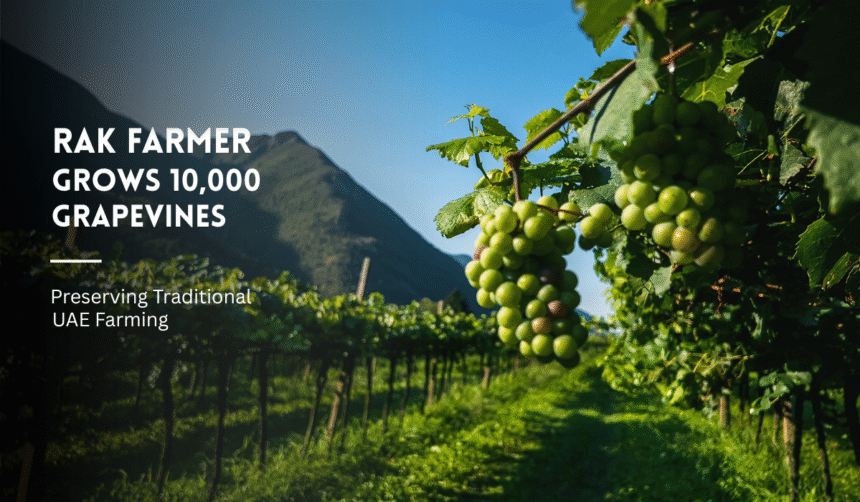
Ras Al Khaimah: Tucked away in the rugged hills of Asimah, around 90 kilometres south of Ras Al Khaimah city, a local farmer is helping preserve one of the UAE’s traditional farming practices by turning a small family venture into a thriving grapevine nursery.
Marwan Saif Rashid Al Mazrouei has transformed what began as a modest operation into a nursery producing more than 10,000 grapevine seedlings every planting season. Built on knowledge passed down through generations, the nursery has become one of the region’s most sought-after sources of locally grown grapevines, with demand continuing to rise.
A Family Tradition That Continues to Grow
Al Mazrouei inherited the craft of grapevine propagation from his father, learning the techniques that have long been practised in the mountainous villages of Ras Al Khaimah.
The nursery initially produced around 500 seedlings each year, but growing interest from farmers and home gardeners has led to remarkable expansion. Today, the farm produces more than 10,000 seedlings every season, with demand often exceeding supply.
The growth reflects a wider movement across the UAE, where interest in locally grown produce and sustainable farming has increased alongside efforts to strengthen domestic agriculture.
Rising Demand for Local Grapevines
According to Al Mazrouei, buyers are increasingly seeking locally adapted grape varieties instead of imported alternatives. The popularity of Emirati grapevines has grown steadily as more people embrace traditional farming and home cultivation.
The increasing demand also aligns with the country’s broader focus on food security and agricultural sustainability, encouraging greater support for locally produced crops.
Farming by the Seasons
Harvest timing depends largely on weather conditions. This year, grape harvesting extended from May through June, with temperature variations influencing the pace of ripening.
Work on the vines begins much earlier. Every February, the grapevines are carefully pruned to encourage healthy growth before entering months of fertilisation, irrigation and pest management.
Some of the nursery’s original mother vines are now more than 25 years old, continuing to provide healthy cuttings for new seedlings year after year.
The farm maintains around 30 to 40 mature vines, with each producing an average of 30 kilograms of grapes per season, although yields vary depending on weather conditions.
Two Traditional Grape Varieties
The nursery specialises in two well-known local grape varieties.
The red variety produces smaller grapes but matures more quickly, making it popular among growers looking for faster results.
The green variety, meanwhile, produces larger and juicier grapes but requires more time before the young vines become fully established.
Rather than selling grapes directly, the nursery focuses on producing healthy grapevine seedlings that are supplied to farmers and gardening enthusiasts across the emirate and beyond.
Al Mazrouei has also started experimenting with several international grape varieties, although these remain in the early stages of cultivation.
Preparing for the Next Planting Season
Fresh grapevine seedlings are expected to become available during the next planting season, which typically begins in September and October.
As interest in local farming continues to grow, family-run nurseries like Al Mazrouei’s are playing an increasingly important role in preserving the UAE’s agricultural heritage while supporting sustainable food production.
From a small nursery producing just a few hundred vines to one supplying more than 10,000 grapevine seedlings every year, the story of this Ras Al Khaimah farmer highlights how traditional knowledge, patience and dedication continue to strengthen the future of agriculture in the UAE.