

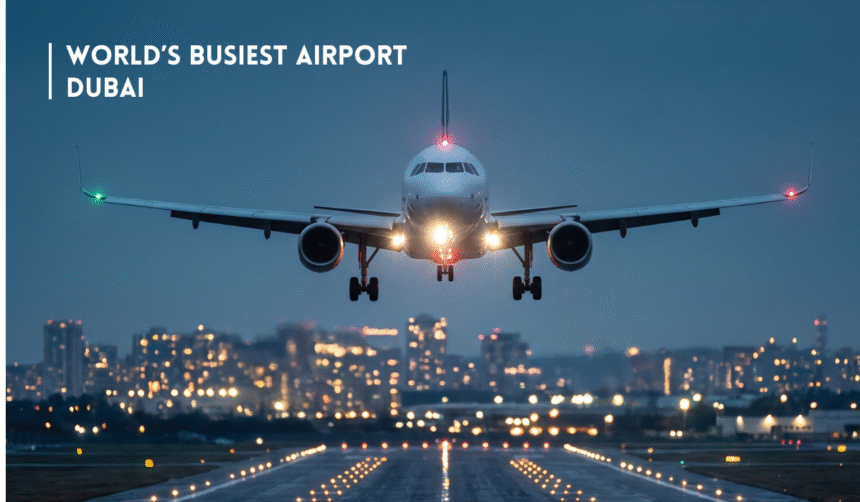
With 8.94 million scheduled seats, Dubai International continues to connect millions of travellers to destinations across the world.
For millions of travellers, Dubai is more than a destination. It is also a place where journeys between continents meet. Whether passengers are travelling for holidays, business or family visits, Dubai International Airport (DXB) remains one of the world’s most important gateways for international air travel.
The airport has retained its position as the world’s busiest airport for scheduled international seat capacity in November 2026, with airlines offering approximately 8.94 million seats across arriving and departing international flights.
According to aviation data provider OAG, airlines have scheduled 4.47 million departing international seats from Dubai this month. When arriving flights are included, the figure reaches approximately 8.94 million seats in both directions.
The latest ranking highlights the scale of Dubai’s international connections and its continuing importance to the global aviation industry.
Dubai Maintains a Clear Lead Over Global Rivals
Dubai International has maintained a substantial advantage over other major international airports, including London’s Heathrow Airport, which secured second place with 3.79 million scheduled international seats.
The difference between the two airports is nearly 680,000 seats, giving Dubai a considerable lead in the November rankings.
Seoul’s Incheon International Airport followed in third place with 3.7 million seats, while Singapore’s Changi Airport ranked fourth with 3.58 million. Amsterdam Schiphol Airport completed the top five with 3.25 million seats.
Hong Kong International Airport secured sixth position with 3.19 million seats, followed by Istanbul Airport with 3.16 million and Paris Charles de Gaulle Airport with 3.08 million.
Bangkok’s Suvarnabhumi Airport ranked ninth with 2.82 million seats, while Frankfurt Airport completed the top 10 with 2.65 million.
The figures demonstrate the competition among major aviation hubs to maintain extensive international networks and accommodate demand for travel between countries.
A 16% Decline Has Not Affected Dubai’s Top Position
Despite maintaining its leading position, Dubai International recorded a 16 per cent decline in scheduled international seat capacity compared with November 2025.
The reduction indicates that the airport’s position at the top does not necessarily mean its available capacity has increased over the previous year.
However, its lead over competing international airports remains significant.
This distinction is particularly important when understanding aviation rankings. Scheduled seat capacity measures how many seats airlines plan to offer on their flights, rather than how many passengers actually travel.
The final number of passengers can vary depending on bookings, cancellations, flight changes and seat occupancy.
For travellers, the ranking therefore provides an indication of the scale of flight services planned through Dubai rather than a confirmed count of airport visitors.
Emirates and flydubai Support Dubai’s International Network
A major factor behind Dubai International’s position is its role as the main hub for Emirates and flydubai.
Both airlines operate extensive international networks, connecting Dubai with destinations across different regions.
Emirates provides connections to major international cities, while flydubai adds further routes across the Middle East, Africa, Europe and Asia.
Their networks allow passengers to travel directly to Dubai or use the airport as a connecting point when travelling between different countries.
For example, someone travelling between Europe and Asia may choose Dubai as a transit point, making it possible to connect between flights through a single major aviation hub.
Other international airlines operating at DXB also contribute to its extensive network, strengthening connections between Asia, Europe, Africa and the Americas.
This makes the airport relevant not only to international tourists visiting the UAE but also to passengers whose final destinations are elsewhere.
Dubai’s International Ranking Differs From Its Overall Position
Although Dubai International leads the world in scheduled international seat capacity, its position changes when domestic flights are included.
In the overall global ranking, which considers both domestic and international scheduled capacity, DXB placed fourth.
Atlanta, Chicago and Tokyo ranked ahead of Dubai in this category.
The difference reflects the importance of domestic aviation networks in countries with large internal markets. While airports such as Atlanta and Chicago serve extensive domestic routes, Dubai’s aviation network is strongly focused on international connections.
As a result, Dubai’s leading position in international capacity highlights a different strength from airports that handle substantial domestic and international traffic.
What This Means for Travellers
Dubai International’s latest ranking reinforces the emirate’s importance as a global travel connection point.
For residents, tourists and business travellers, an extensive international network offers access to destinations across several continents. It also provides more opportunities to connect through Dubai when direct flights between two cities are unavailable or less convenient.
The airport’s position is also closely linked to Dubai’s tourism and hospitality sectors, as international flight connections help visitors reach the emirate for holidays, business meetings and family occasions.
With 8.94 million scheduled international seats in November, Dubai International continues to demonstrate the scale of its global reach.
Although its scheduled capacity has declined compared with last year, the airport has retained a clear lead over its international competitors, keeping Dubai firmly at the centre of global aviation.