





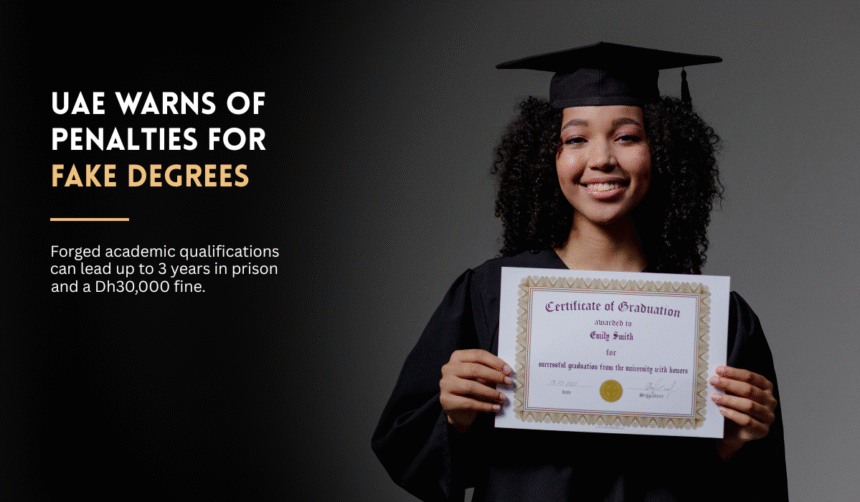

People found guilty of forging academic qualifications in the UAE can face serious legal consequences, including prison sentences of up to three years and fines reaching Dh30,000, authorities have warned.
The Ministry of Higher Education and Scientific Research has reiterated its efforts to protect the credibility of academic qualifications issued by universities and higher education institutions inside and outside the UAE. The ministry said it has strengthened verification and monitoring procedures to identify suspicious or manipulated certificates and ensure that academic records remain reliable.
The warning comes as the number of academic qualification verification requests continues to grow across the country. The ministry processed 178,600 requests in 2025, with the figure reaching 253,000 by the beginning of September 2026.
Despite the increase in verification activity, authorities said cases involving fraudulent qualifications remain isolated compared with the overall number of certificates being processed.
UAE strengthens checks on academic qualifications
The ministry said protecting the authenticity of academic qualifications is an important part of maintaining confidence in the country’s higher education system.
Ahmed Abdullah Al Hammadi, Director of the Legal Affairs Department at the Ministry of Higher Education and Scientific Research, said safeguarding the credibility of qualifications remains a priority, regardless of whether the certificate was issued inside the UAE or overseas.
The ministry’s verification framework is designed to identify discrepancies at an early stage. Where a case raises concerns of a possible criminal offence, it can be referred to the relevant judicial authorities for further action.
The authorities are also working with the Ministry of Justice, the Federal Public Prosecution and local prosecution authorities as part of efforts to address suspected cases of academic certificate fraud.
What can be considered academic certificate forgery?
Academic certificate fraud can take several forms. It may involve creating a completely fake qualification, changing information on a genuine certificate or transcript, adding or removing details, or knowingly using a document that has been forged or manipulated.
Such practices can have wider consequences because employers and institutions may rely on academic qualifications when making decisions about recruitment, professional positions and other opportunities.
A fraudulent certificate can therefore affect not only the individual presenting it but also organisations that rely on inaccurate academic information.
Under Article 252 of Federal Decree-Law No. 31 of 2021 on Crimes and Penalties, forgery of an official document can carry a prison sentence of up to 10 years, while other forms of document forgery can attract separate penalties. The ministry has also pointed to court rulings in academic qualification forgery cases where prison sentences of up to three years and fines of up to Dh30,000 were imposed.
Authorities urge employers to verify certificates
The ministry has encouraged government bodies, private companies and employers to use approved verification channels when there are concerns about the authenticity of an academic qualification.
For individuals, obtaining qualifications through legitimate educational institutions and ensuring that documents are properly verified can help prevent problems at a later stage.
Employers also have an interest in carrying out appropriate checks before relying on academic records during recruitment or professional appointments. The verification process can help identify inconsistencies before a qualification is used for employment or other official purposes.
The ministry said it is continuing to develop its digital verification, monitoring and information-sharing systems to make the process faster and more accurate.
Digital verification demand rises in UAE
The sharp rise in verification requests reflects growing use of digital systems by individuals, institutions and employers seeking confirmation that academic qualifications are genuine.
The ministry recorded 178,600 academic qualification verification requests during 2025. By early September 2026, that number had already climbed to 253,000.
Authorities stressed that the relatively small number of detected fraudulent cases should be viewed against this much larger volume of qualifications being checked.
The ministry said its verification and monitoring mechanisms are intended to support early detection of irregularities while ensuring that suspected criminal cases are dealt with through the appropriate legal channels.
UAE maintains strict approach to forged qualifications
The latest warning highlights the UAE’s continued focus on maintaining the integrity of academic credentials and preventing fraudulent qualifications from entering the education and employment system.
Authorities have made clear that suspected cases involving forgery, alteration or manipulation can be investigated and referred to the competent judicial authorities where criminal conduct is suspected.
With qualification checks becoming increasingly digital, individuals and organisations are being encouraged to rely on official verification procedures rather than accepting academic documents at face value.
For anyone seeking employment, professional recognition or official approval in the UAE, ensuring that academic certificates are genuine and properly verified remains essential. The penalties imposed in previous cases also underline the potential legal consequences of attempting to use fraudulent academic credentials.